Charlie Kaufman: The Philosophy Behind His Surrealist Screenplays
I like that Charlie Kaufman’s work mocks every coil of my brain for what it thinks is possible. Identity, subjectivity, freedom, love, social acceptance, and philosophy are all themes that permeate his films, yet challenge everything I think I understand about them. I find it quite challenging to articulate exactly why I am drawn to Charlie Kaufman’s work, because it honestly makes me deeply uncomfortable.
Kaufman doesn’t treat his audience like they’re dense; he leaves room for interpretation and conversation. He doesn’t follow tropes. He mixes reality and imagination with artistry. His movies are totally bizarre. Many people hate them, and I’m proud to be one of his fans. I love that he makes me confront ideas that make my skin crawl. His work has caused me to examine my life in new ways; to examine how I want to just exist.
Through the philosophical ideas explored in the films Eternal Sunshine of the Spotless Mind, Being John Malkovich, and Adaptation, Kaufman probes the paradoxical nature of human existence: its simultaneous simplicity and complexity. His distinctive cinematic voice addresses audiences with an unsettling sense of self-consciousness, challenging our perceptions of identity, reality, and the human condition. His films echo and reinterpret philosophical ideas associated with Friedrich Nietzsche, Abraham Maslow, David Hume, Jean Baudrillard, Jacques Derrida, John Locke, and Jean-Jacques Rousseau. Yet Kaufman’s work does more than simply illustrate existing philosophical theories. He brings them to life, transforming abstract questions into deeply human experiences. His films invite us not only to reconsider established philosophical ideas but also to confront the existential questions that shape our own lives.

Eternal Sunshine of the Spotless Mind (2004), directed by Micheal Gondry and written by Charlie Kaufman, is one of Kaufman’s most Nietzchean films to date. Set in Long Island, New York, Clementine (Kate Winslet) undergoes a procedure to erase Joel (Jim Carrey) from her memory after a heart-wrenching breakup. Joel finds out by accident and, in a heartbroken state, undergoes the surgery himself. Both characters go on a journey inside of their own psyches to understand what went wrong in their relationship, and in doing so, they realize that human nature is repetitive and that by both of them erasing their memories of each other, they will inevitably meet again, and their cycle will repeat ad Infinium.
This film heavily references both Nietzche and Locke but in opposing lights. Both philosophers believe that memory and the psychological weight of man’s actions are important, but Nietzche believes forgetting is just as important. To quote Netizche’s 1873 book, Untimely Meditations,
“In the smallest as in the greatest happiness, it is something that happiness is happiness: the ability to forget, or to put it in terms most learned, the ability to feel things, as long as happiness lasts, without any historical perspective. The man who is unable to sit on the threshold of the moment, forgetting all past events, which can not, without dizziness and fearless, stand a moment while standing as a victory, will never what a happiness, and what is worse, it will never do anything to give happiness to others.”
His theory goes against Locke who considers memory the foundation of identity, but this movie supports the ideas of Nietzche that forgetting is essential to human sanity. Locke believes that:
“Memory is the power to revive again in our minds those ideas which after imprinting have disappeared, or have been laid aside out of sight.”
Amnesia becomes a creative outlook for Joel and Clementine; it’s the only time their minds are completely free. The hypermnestic (ability to forget) is unalloyed nostalgia, which Nietzsche believes is how man can feel liberated from himself. In the Eternal Sunshine world, humans have evolved emotionally and have higher expectations of their partners; they are more idealistic. The characters love without presumption. This idealization that their partner would become the reciprocal of their ambitions, rather than their complement, is a significant problem. The main characters see loved ones as entirely subordinate to their personal desire for perfection and happiness. They can snap it away when their wishes for their significant other no longer comply with their idea of perfect love. The characters have forgotten that humans are full of deficits.
Joel loved Clementine for the parts of her that complemented himself, which brings up Nietzsche’s theory of eternal recurrence. “Blessed are the forgetful, for they get the better even of their blunders.” Nietzsche believes that people need to be able to forget to handle their own experiences. Remembering every detail of life would drive people insane…forgetting is essential to staying sane. Kaufman challenges Nietzsche with the idea that remembering acknowledges all elements of life that lead us to live an authentic life because, in Nietzschean philosophy, even if something is doomed, the present should still be celebrated. Joel and Clementine’s entrapment and repetition show a sense of fatality flipped on its opposite. Kaufman and Nietzsche both see traps set for us in our own minds and surroundings.
“My formula for greatness in a human being is Amor Fati: that one wants nothing to be different, not forward, not backward, not in all eternity. Not merely bear what is necessary, still less conceal it—all idealism is mendacity in the face of what is necessary—but love it.”
Kaufman’s screenplay asks: is what I want at this moment what I will want for the rest of my life? Joel and Clementine make the intangible decision of making no decision at all. The true beauty of this story is that they don’t learn from their mistakes. They draw no lessons from their choices, and like amnesiacs, they choose a life of dull wisdom because they choose to forget. They must actually believe that ignorance is is bliss. They transcend suffering through brief, pure affirmations of life, believing their good experiences outweigh the pain they will inevitably endure when the cycle repeats.

One of Charlie Kaufman’s first screenplays was turned into the 1999 film, Being John Malkovich, directed by Spike Jonze. Set in New York City on the 7½ floor, a puppeteer with a severe lack of artistic recognition named Craig (John Cusack) discovers a metaphysical portal where people can live through the eyes of actor John Malkovich for 15 minutes when he is forced to enter corporate America at a boring office job. Craig serves as the audience’s portal into Kaufman’s absurdist fantasy version of New York City and as a canvas to paint themes of personal identity and subjectivity. The movie’s John Malkovich portal is a play on the saying “15 minutes of fame,” as those who enter can only experience Malkovich’s senses for 15 minutes. Craig is a deeply flawed main character who ignores his girlfriend, Lotte (Cameron Diaz), and pursues another woman, Maxine (Catherine Keener), with whom he turns the portal into a profitable business for soul-searching humans in NYC. Craig uses the portal for his own personal gain, allowing Kaufman to explore the spiritual substance of Cartesian dualism.
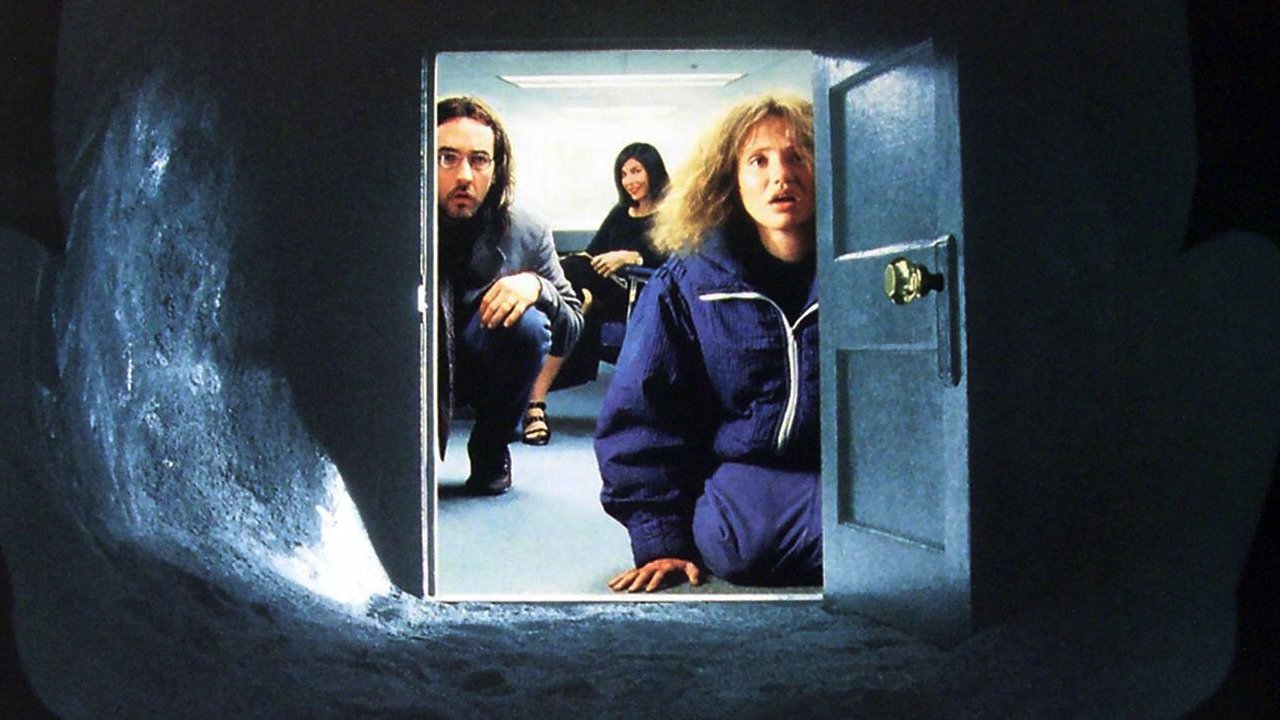
Cartesian dualism, famously supported by René Descartes, argues that there are two kinds of foundation: mental and physical. The mind can exist outside the body, and the body cannot think. This is directly represented in the POV shots where outsiders enter the eyes of John Malkovich. Those who enter the portal experience what it is like to shower, enter a taxi, and even have sex as John Malkovich.
Nietzsche is not forgotten in this film, and his theory of the individual as a hierarchy of dominant and submissive drives is one of the central themes of Being John Malkovich. Kaufman’s screenplay presents Malkovich as one of the weak wills, while Nietzsche’s philosophy suggests that the drive that wins is the one that leads to action. Individuals have power drives, that we are our actions, and that who we become depends on our strength of will.
This brings up “unfree wills” as mythology. There is only free will, an individual’s capacity to choose between unimpeded different possible courses of action. becuase Craig strives and struggles to reach his full potential, he views the portal as the solution to his problems. The portal then turns into an existential escape from the mundane and tedious truths of his livelihood.
The invariant struggle of acquiring and honing potential mirrors 20th-century philosopher Abraham Maslow’s theory of “self-actualization,” the very process of a person reaching their full potential. Maslow created the “hierarchy of needs” based on how an individual can achieve pure self-fulfillment. Yet In Kaufman’s screenplay, the characters use the Malkovich portal to work their way up the pyramid.
Unlike Eternal Sunshine, Being John Malkovich asks what art represents, if it even means something at all. All characters, most notably Craig, frequently think about their purpose in life and whether their art is important to anyone except themselves. The characters have high expectations for themselves, and living through Malkovich lets them confront themselves in their truest extent, showing how Kaufman utilizes David Hume’s conclusions about self-identity.
18th-century philosopher David Hume believed that the self was an illusion and a “bundle of perceptions.” Hume declares that we have no experience of a simple, individual impression that we can call the self, where the “self” is the entirety of someone’s cognizant life. Being John Malkovich supports Humean conclusions about self-identity, exploring the existential position of selfhood and critiquing the autonomous self.
Kaufman’s ideas of self are apparent in the script, yet he doesn’t aim to solve the problems of self-consciousness posed by the philosophers who influenced him; he actually makes them more problematic. Kaufman creates an utterly absurdist work of art from assorted philosophers’ ideas of self. While ideas of “self” ring throughout the film, it is also a statement on one’s internal ego, celebrity culture, and pretentious inauthenticity.
Toward the film’s end, Kaufman poses a new question to the audience: why is there something instead of nothing? This relates to Jean Baudrillard’s views on how humans use self-identity to protect their egos. Self-identity becomes a tool for responding to how they view the world and how they believe it has treated them. The film’s protagonist shows the modern predicament of chasing celebrity culture instead of pursuing an authentic, self-configured art form. Craig claims to suffer for his art, but he really suffers for the banality of his art. “We can live without a mode of identity because the nothingness of the self is liberatory,” claims Baudrillard. “Nobody is looking for a puppeteer in today’s wintry economic climate,” claims Craig Schwartz.
Baudrillard’s theories complement Nietzsche’s because the film explores people from the inside out, not the outside in. Both Baudrillard and Nietzsche believe in the “dissolution of the will” and rejection of the ego, which Kaufman projects through the script. Kaufman warns viewers that the failed desires of artists are an allegory of the nature of desire and the structuring of contemporary art itself. His protagonist believes he’s missing the métier that will unify him; his quest for fame poisons his view of his own selfhood. Because Craig measures his life in terms of social acceptance of his art rather than the more deeply formed creative alterity, he never realizes the psychological danger of what he’s doing. Kaufman and Baudrillard both encourage a destabilization of the commonsensical idea of conceited personal identity, and because this is an absurdist Kaufman movie, Craig never learns his lesson.
At the film’s utterly absurd climax, Craig discovers he can control Malkovich forever. He inhabits him for the next eight months, using Malkovich’s fame to turn himself into the world’s greatest puppeteer. Even after all Craig has witnessed through Malkovich, he lusts after his celebrity reputation, knowing that while Craig, the office worker, cannot become a famous puppeteer, John Malkovich, the actor, can and will succeed. But things don’t end so smoothly for Craig. In his new body, he marries and impregnates Maxine. When his ex-wife, Lotte, demands that he leave Malkovich’s body, he is eventually tricked into doing so. Lotte and Maxine declare their love for each other, and Craig quickly tries to re-enter the Malkovich portal. But the doorway to Malkovich has closed, and he instead enters the mind of Maxine’s daughter, to whom the portal has passed. Craig ends the film permanently trapped in the daughter, forced to watch Maxine and Lotte live happily ever after.

Spike Jonze directed another Kaufman screenplay just three years after Malkovich. Adaptation (2002) is a wildly different film from the previous two discussed. Not only is it a movie about making movies, but it’s also a movie about Charlie Kaufman himself, and the meta-ness adds a layer of honesty, comedy, and empathy to the characters. Kaufman is incredible at blurring the lines of fiction and reality, and Adaptation feels as though it meets the documentary and drama genres halfway. The movie is about the making of itself, and the audience watches screenwriter Charlie Kaufman (played by Nicolas Cage) writing the very scene we are watching, creating an unremitting hall of mirrors effect of meta-reflexive self-scrutiny.
The context of the film is that Charlie is hit with a terrible case of writer’s block as he attempts to adapt The Orchid Thiefby Susan Orlean (Meryl Streep) into a screenplay. Orlean and Kaufman’s lives become entwined as their searches for self clash. The movie is a piece of dramatic fiction, but it is about a nonfiction book, which, technically, makes it a nonfiction film. The audience is constantly questioning what they are watching, and so are the characters. They go on this journey of discovery together, and no one knows more than the other at any given point about what is occurring on screen.

This film is repeatedly mindful of the push-pull dynamic between depicting real life and the imaginary sensationalism that’s important for any endeavor to retell a narrative through the silver screen. Kaufman combines Hollywood genre norms with incredibly abstract yet self-aware declarations that it’s almost impossible to tell what is real and what is a fabrication. The magical mystery of Kaufman is that he doesn’t desire you to find a disparity between the two.
As mentioned previously, Adaptation stands distinct from Eternal and Malkovich because it is a pure meta film. The opening shot is just a dark screen, and we hear Charlie’s forlorn voice as he lists all the things he hates about himself, “I’ve got a fat ass,” and “I’m bald.”
Part of why this movie is so unique is its use of deconstructionist components. Deconstruction is a form of philosophical and literary analysis popularized in the 1960s by French philosopher Jacques Derrida. Deconstruction questions the fundamental abstract distinctions in Western philosophy through a reevaluation of reason and rhetoric in literary and philosophical texts. These distinctions have been ingrained in Western philosophy since the Ancient Greeks and are intrinsically “binary” and “hierarchical.” This philosophy relies on pairs of representations in which one part is fundamental and the other is derivative, such as mind and body, nature and culture, literal and metaphorical, and inside and outside.
Exploring deconstruction means exploring the uncertainty and contradictions within the hierarchical structures that are socially accepted or explicitly claimed in a text. This is especially important when aspects of the text’s meaning are implied or indirect, depending on metaphorical or performative wording. Through this analysis, the resistance exhibited becomes a product or construction of the text. One of the most essential parts of deconstruction is questioning the boundaries and binaries that Western philosophy has relied on for centuries.
Adaptation completely removes the border between the writer and his story, turning the visionary writing process into the plot while simultaneously keeping the narrative ambiguous. The book being adapted into a film is a significant part of the action, but the emphasis remains on the frustrations of being a writer. Both Kaufman and Derrida go against set genre norms. The most notable use of Derrida’s deconstruction within Adaptation is how it makes fun of itself and victimizes itself through cathartic reflection. To write this screenplay, Kaufman had to deconstruct his own creative process and disable any foundational confidence he had in himself.
Unlike Derrida, philosopher Jean-Jacques Rousseau believed that culture and society are corrupting and overpowering energies that evolve out of an idyllic “state of nature,” in which humans live in self-sufficient and tranquil seclusion from one another. He believed that nature precedes culture, but there is a sense that nature is a product of culture, and what counts as “nature” depends on the culture of the moment. For Derrida, the purpose of deconstruction is to displace the opposition, not just invert it.
While Adaptation is the most blatant sample of this, part of what makes all of Charlie Kaufman’s screenplays so immersive, humorous, tragic, and fun is that they summon analysis. Every line of dialogue, every shot, and every sound heard links back to an underlying conception or chorus of the film. Possibly it is Kaufman’s sharp commentary on the human mentality and experience that I have reverberated with and drawn much inspiration from that keeps me rewatching his movies, or maybe I just enjoy burdening myself with the weight of existential queries. I still don’t know what to make of these films, and I feel like that’s exactly how Kaufman wants it.